1. Introduction to Binding and Library Binding
Binding: Binding is the process of assembling, joining and securing individual sheets or folded sections of a document to form a book or another unified publication, usually with a protective cover. It provides structural support, maintains the correct arrangement of pages and makes the publication suitable for handling, reading, storage and repeated use. The process may involve folding, gathering, sewing, adhesive application, spine preparation, cover construction and finishing, depending on the binding method and intended use.Bookbinding: Bookbinding refers to the physical and technical processes through which the pages of a book are assembled and attached to a protective covering. Traditional bookbinding frequently uses sewing and manually constructed covers, while modern commercial binding may employ automated machinery and adhesive techniques. Regardless of the method, the principal objective is to produce a functional structure that securely holds the pages together and permits convenient reading.
Library Binding: Library binding is a specialised form of binding designed to withstand the repeated handling, circulation, shelving and consultation associated with library use. It may involve the first-time hardcover binding of paperbound publications, the binding of accumulated periodical issues or the rebinding of damaged volumes. Unlike ordinary commercial binding, library binding places particular emphasis on durability, flexibility, comfortable opening and the preservation of the original text block.
Binding and Rebinding: Binding generally refers to the initial assembly of a publication into a bound volume, whereas rebinding involves replacing or reconstructing an existing binding that has become damaged or unsuitable. Rebinding may include replacing the cover, repairing the spine or reattaching loose pages. However, complete rebinding is not always necessary. If the original sewing remains intact, replacing the damaged cover through recasing may be sufficient.
Library Binding and Conservation Binding: Library binding is primarily intended for circulating and general collections where durability and economy are important. Conservation binding is a specialised intervention designed to preserve a book's physical structure, historical characteristics and documentary significance. Books possessing rare, historical, artistic or other artifactual value should be assessed by a qualified conservator rather than subjected automatically to commercial library rebinding.
2. Essential Terminology Used in the Binding Process
- Text Block: The text block is the complete assembly of pages or sections forming the main body of a book, excluding its outer cover. Its physical condition determines which binding methods can be used safely.
- Leaf: A leaf is a single sheet of paper within a book. Each leaf normally contains two pages, one on its front and another on its reverse side.
- Signature or Section: A signature is a group of sheets folded together to form a unit within a book. Several signatures may be sewn together to produce the complete text block.
- Spine: The spine is the edge of the book where its pages or sections are joined. It is an important structural component because it helps maintain the connection between the pages and the cover.
- Endpapers: Endpapers are sheets placed at the beginning and end of a book. In many hardcover bindings, they help attach the text block to the cover and protect the adjacent pages.
- Boards: Boards are rigid materials used to form the front and back covers of a hardcover book. They are commonly made from specialised bookbinding board.
- Case: A case is a separately constructed book cover consisting of front and back boards, a spine structure and covering material. The completed text block is subsequently attached to the case through a process known as casing-in.
- Collation: Collation is the process of examining and arranging pages, sections or periodical issues in their correct sequence. It also includes checking whether pages, illustrations, maps or other components are missing or incorrectly positioned.
- Leaf Attachment: Leaf attachment refers to the method used to secure individual leaves or folded sections into a text block. Common methods include sewing, adhesive binding and mechanical fastening.
- Forwarding and Finishing: Forwarding refers to the structural operations used to prepare and assemble a book, such as sewing, spine preparation and board attachment. Finishing refers to the final operations, including covering, lettering, decoration and inspection, although the precise use of these terms may vary between binding traditions.
3. Objectives and Principles of the Binding Process
- Physical Protection: The binding should protect pages against detachment, mechanical damage and excessive wear. Properly constructed covers and spine supports help maintain the physical integrity of the publication.
- Durability: The binding should withstand the expected frequency of handling and use. This is particularly important for textbooks, reference books and frequently circulated library materials.
- Flexibility and Openability: A well-designed binding should permit the book to open comfortably without placing excessive pressure on the spine or inner margins. The Northeast Document Conservation Center (NEDCC) emphasises that good library bindings should open easily and support convenient consultation without damaging the text block.
- Minimal Alteration: Binding should preserve as much of the original material as possible. Unnecessary trimming, removal of original sewing or reduction of page margins can cause permanent information loss. Modern library binding guidance therefore favours procedures that minimise changes to the original text block.
- Material Compatibility: Boards, adhesives, thread, covering materials and endpapers should be compatible with the physical and chemical characteristics of the publication. Unsuitable materials may cause staining, brittleness, weakened attachment or other deterioration.
- Economy and Suitability: The binding method should provide appropriate protection at a reasonable cost. The most expensive or strongest method is not necessarily the most suitable. Binding decisions should consider the physical condition, importance, expected use and retention requirements of the material.
4. General Binding Process
Meaning of the Binding Process: The binding process is a sequence of technical activities through which loose sheets or folded sections are assembled, secured, protected and finished as a usable publication. The precise sequence varies according to whether the material is newly manufactured, repaired or rebound. In general, the process includes examination, collation, preparation of the text block, leaf attachment, spine reinforcement, cover construction, casing-in and finishing.- Examination and Assessment: The binding process begins by examining the material to determine its size, thickness, page arrangement, paper condition, existing structure and intended use. Particular attention is given to loose pages, damaged sections, brittle paper, inadequate margins and valuable original features. Assessment helps determine whether the material is suitable for ordinary binding, requires specialised repair or should be placed in a protective enclosure.
- Collation and Arrangement: Pages or sections are checked for completeness and arranged in their correct sequence. In books, this involves verifying page order, illustrations, folded plates and other components. In periodicals, individual issues are arranged according to volume, issue number and publication date. Proper collation prevents missing, duplicated or incorrectly arranged pages from becoming permanently incorporated into the completed binding.
- Preparation of the Text Block: The text block is prepared according to the selected binding method. For newly produced books, printed sheets may be folded and gathered into signatures. For rebinding, loose pages may be aligned, damaged components assessed and unsuitable remains of an earlier binding removed only where necessary. Original sewing and other structural features should be retained whenever their preservation is appropriate.
- Leaf Attachment: Pages or signatures are secured using a suitable method, such as section sewing, perfect binding or double-fan adhesive binding. The choice depends on the construction of the text block, paper strength, thickness and expected use. Proper attachment is essential because inadequate sewing or adhesive application may cause pages to detach during handling.
- Spine Preparation and Reinforcement: After the pages are secured, the spine may be shaped, reinforced and prepared for attachment to the cover. Depending on the binding structure, suitable adhesives, spine linings, cloth, paper or other supporting materials may be applied. These components help distribute mechanical stress and support the connection between the text block and the covering.
- Cover or Case Construction: A protective cover is prepared according to the dimensions and structure of the text block. Hardcover bindings commonly use rigid boards joined by a spine covering and covered with book cloth or another suitable material. The cover should fit properly and permit the book to open without excessive strain.
- Casing-In: Casing-in is the process of attaching a prepared text block to a separately manufactured case. In many case bindings, the endpapers are adhered to the inside surfaces of the cover boards. Accurate positioning is essential to prevent distortion, weak attachment or difficulty opening the book.
- Finishing and Inspection: The completed book may receive spine lettering, title information, volume numbers and other identifying details. It is then examined to verify page alignment, binding strength, cover attachment, opening characteristics and overall workmanship. Defective bindings may require correction before the volume is accepted for use.
5. Methods of Leaf Attachment in the Binding Process
Section Sewing: Section sewing joins folded signatures by passing thread through their folds. The signatures may be sewn directly to one another or supported by tapes or cords. Properly constructed section sewing provides a durable and flexible structure and is suitable for many books intended for long-term use. In conservation work, existing sewing stations may be reused to minimise alteration of an original text block.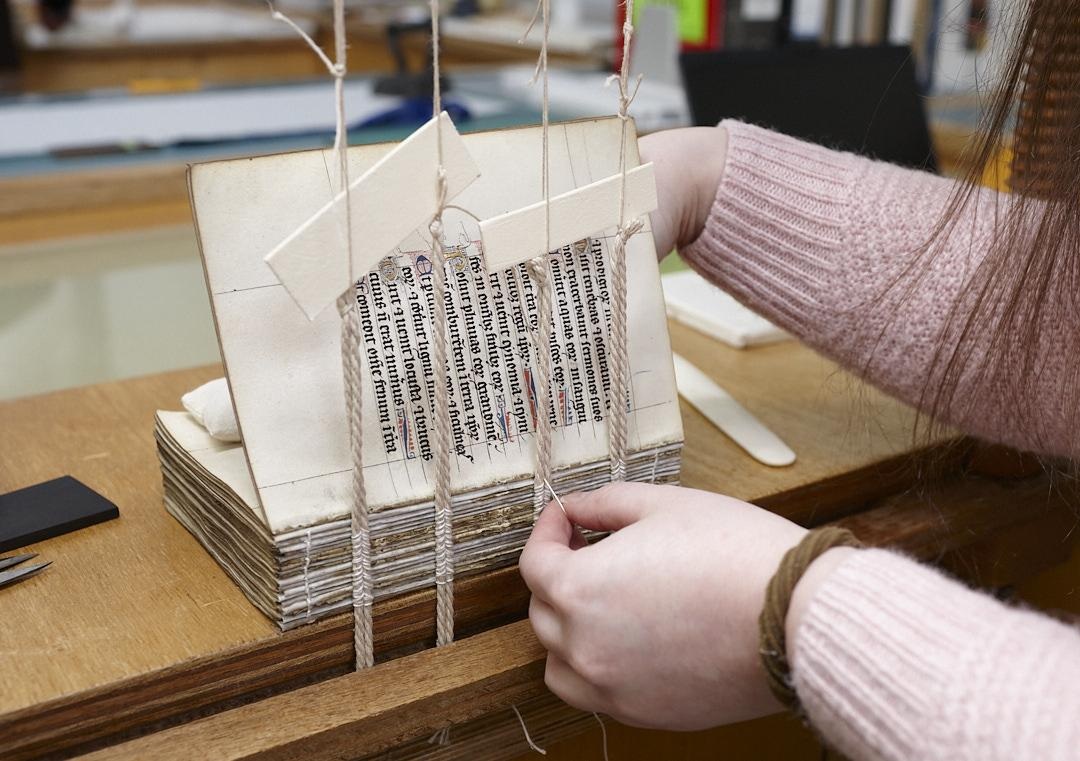
Figure: A conservator sewing folded manuscript sections onto supporting cords. Source: Trinity College Dublin Library.
Oversewing: Oversewing joins groups of individual leaves by passing thread through holes made near the inner margins. Although it can provide a strong structure for certain thick or heavy volumes, oversewing may restrict opening and damage weakened paper. Contemporary preservation guidance therefore recommends using it only in limited circumstances where more suitable alternatives are unavailable.Perfect Binding: Perfect binding is an adhesive technique commonly used for paperbacks and commercial publications. Individual leaves are aligned, the spine is prepared and adhesive is applied to secure the pages. The effectiveness of the binding depends on the quality of the adhesive, spine preparation and paper characteristics. Poorly constructed perfect-bound books may develop cracked spines or detached pages after repeated use.
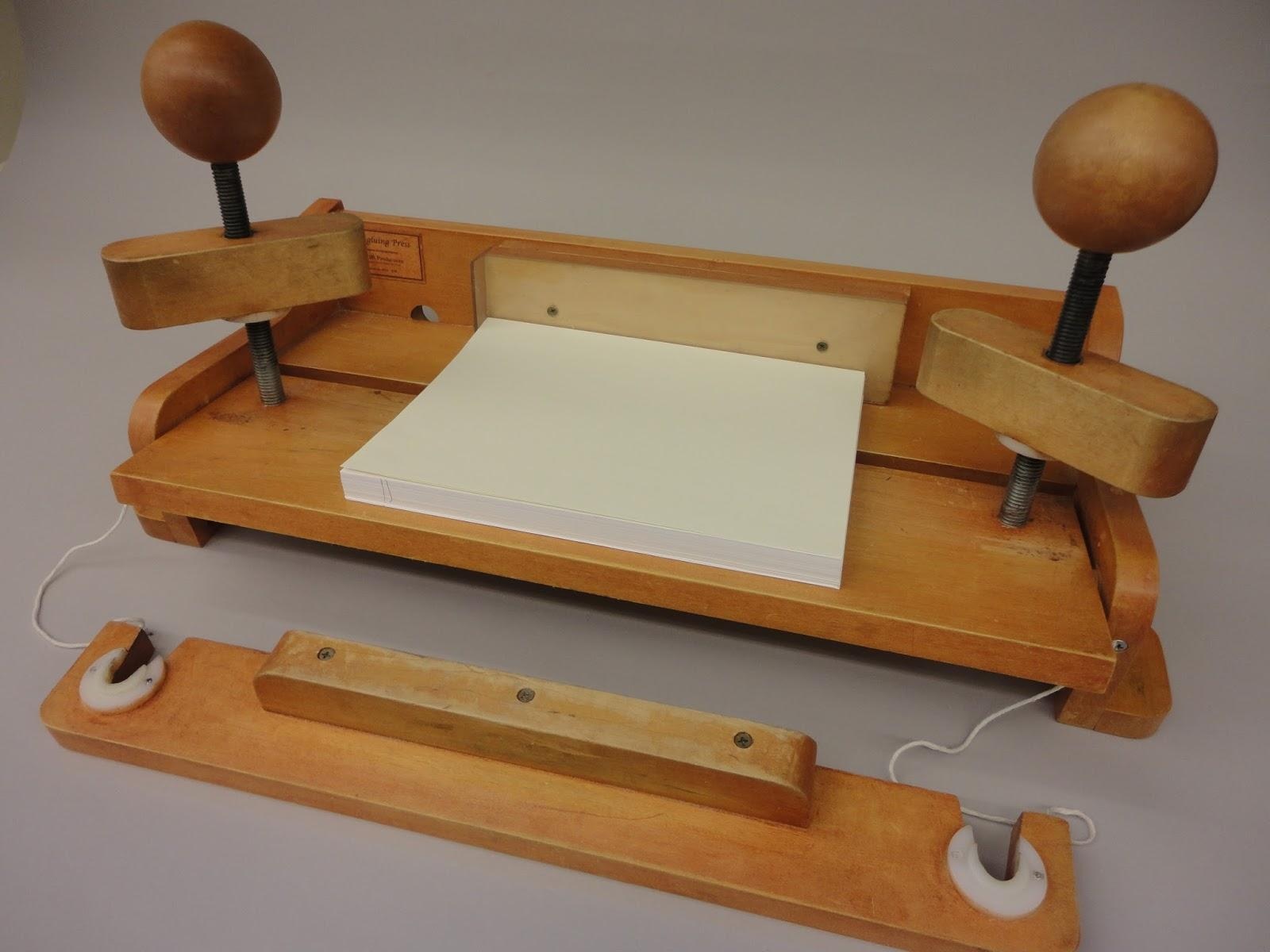
Figure: A text block in a binding press during double-fan adhesive binding. Source: Dartmouth College Preservation Services.
Double-Fan Adhesive Binding: Double-fan adhesive binding involves fanning the leaves of a text block in one direction while adhesive is applied near their spine edges, followed by fanning in the opposite direction and applying adhesive again. This allows adhesive to reach adjoining portions of the individual leaves. When appropriately executed, the method provides flexible and secure leaf attachment and is widely recommended for suitable library rebinding work. Mechanical Attachment: Mechanical attachment uses staples, rings, wires, coils or other physical fasteners to hold sheets together. It is suitable for many pamphlets, booklets, manuals and reports. However, some mechanical bindings may not provide the durability, protection or opening characteristics required for long-term library preservation.
Selection of Attachment Method: A binder should not choose a method solely on the basis of strength. Paper condition, page margins, existing sewing, thickness, flexibility, expected use and preservation value must be considered. For example, double-fan adhesive binding may be appropriate for a modern book with detached individual leaves, whereas a valuable book with intact original sewing may require recasing rather than complete reconstruction.
6. Spine Preparation, Cover Construction and Finishing
- Spine Shaping: Spine shaping refers to preparing the spine of the text block so that the book can open and close appropriately. In some traditional bindings, shaping includes rounding and backing. Rounding produces a curved spine, while backing forms shoulders against which the cover boards may be positioned. These operations are not necessary or suitable for every binding structure.
- Spine Lining: Spine lining involves attaching suitable supporting materials to the prepared spine. Depending on the binding method, these materials may include paper, cloth or other flexible supports. Their purpose is to reinforce the spine and distribute stress during opening and closing.
- Cover Preparation: In hardcover binding, the front and back boards are cut to suitable dimensions and combined with the selected spine structure. Book cloth, paper or another covering material is attached to produce the case. The dimensions must accommodate the text block while allowing adequate movement at the joints.
- Casing-In and Attachment: The text block is positioned within the case, and the attachment is completed through the structure appropriate to the binding. Poor casing-in can result in misalignment, weak hinges, distortion or excessive pressure on the spine. Correct alignment and attachment are therefore essential for durability and comfortable opening.
- Lettering and Identification: The spine or cover may be lettered with information such as the title, author, volume number, publication year or library classification number. In library binding, accurate lettering helps users identify volumes and supports systematic shelving and retrieval.
- Final Pressing and Finishing: Some binding structures require controlled pressing or drying to ensure proper adhesion and shape. The book is subsequently examined for neatness, correct assembly, secure attachment and freedom of movement. Excessive pressing or inappropriate finishing may damage fragile materials, so these operations must suit the particular binding structure.
- Identification and Selection: Library staff identify materials requiring first-time binding, rebinding or repair. Common examples include paperback textbooks, accumulated periodical issues and circulating books with damaged covers. Materials possessing significant historical or artifactual value should be referred for conservation assessment rather than routine commercial binding.
- Physical Examination: Selected materials are examined for damaged pages, brittle paper, weak sewing, defective covers, insufficient inner margins and other physical problems. This examination determines whether the material can safely withstand the proposed binding process.
- Collation of Periodicals and Books: Pages and issues are checked for completeness and correct sequence. Periodicals require particular attention because individual issues may contain supplements, special numbers, advertisements or other components that should not be overlooked. The library must determine the appropriate grouping of issues into bound volumes.
- Preparation of Binding Instructions: Library staff prepare instructions specifying the publication title, volume and issue numbers, publication year, binding method, covering material, lettering and any special requirements. Instructions may also specify that pages should not be trimmed or that particular original features must be preserved.
- Selection of Binding Service: The institution decides whether the work can be undertaken in its own preservation unit or should be sent to a commercial library binder. The decision depends on available expertise, equipment, workload, cost and the nature of the material. Commercial binding contracts should specify appropriate standards and quality requirements.
- Execution of Binding Work: The binder carries out the required operations, including preparation of the text block, leaf attachment, spine reinforcement, cover construction, casing-in and finishing. The selected operations should conform to the agreed specifications and the physical requirements of the material.
- Receipt and Quality Inspection: After binding, the library examines the returned materials for completeness, correct sequence, accurate spine lettering, secure attachment, suitable opening and physical damage. Any defects are recorded and corrected according to the institution's arrangements with the binder.
- Record Updating and Shelving: Binding records, serial holdings, item details and financial records are updated as necessary. Completed volumes are then processed for shelving, circulation or reference use.
8. Standards for Library Binding
Meaning of Binding Standards: Binding standards are formally established technical requirements and guidelines concerning the materials, construction methods, workmanship and performance of bound publications. Their purpose is to promote consistency, durability, functional quality and reliable preservation practices. Standards also provide a common basis for communication between libraries and commercial binders.Importance of Standardisation: Standardisation helps institutions define acceptable binding quality, prepare technical specifications, evaluate commercial services and inspect completed work. It reduces uncertainty concerning materials and methods and helps prevent unsuitable practices that could damage library collections.
Indian Standard IS 3050:2018: The Bureau of Indian Standards (BIS) publishes IS 3050:2018, titled Code of Practice for Reinforced Binding of Library Books and Periodicals (First Revision). The standard provides an Indian standardisation reference specifically concerned with reinforced binding of library books and periodicals. The BIS Programme of Work records that the standard was reaffirmed in February 2023. Its relevance to Indian libraries lies in providing a recognised national reference when specifying and evaluating reinforced binding services. Detailed technical requirements should be consulted in the full official standard rather than inferred solely from its published title or catalogue entry.
ANSI/NISO/LBC Z39.78-2000 (R2018): This American National Standard for Library Binding was developed through the National Information Standards Organization (NISO) and the library binding industry. It specifies technical and material requirements for first-time hardcover binding of suitable paperbound books and serial publications, as well as rebinding of hardcover books and serials intended for library use. The standard was reaffirmed in 2018.
Scope of the ANSI/NISO Library Binding Standard: The standard addresses materials and techniques associated with producing durable library bindings. It recognises different methods of leaf attachment and construction so that binders can select suitable treatments according to the structure, size, age and condition of a volume. Its purpose is not simply to produce strong covers but to support durability, flexibility and continued usability of the text block.
Northeast Document Conservation Center Guidelines: The NEDCC Guidelines for Library Binding provide professional guidance concerning the selection of binding methods, preservation of existing sewing, minimal trimming, suitable materials and inspection of commercial binding work. The guidelines also distinguish ordinary library binding from conservation treatment for historically significant materials.
Relationship Between Standards and Guidelines: Formal standards establish recognised technical specifications, while professional conservation guidelines help libraries interpret preservation requirements and select suitable treatments. Libraries should consult both relevant standards and conservation guidance when preparing binding policies and commercial contracts. The suitability of any particular standard also depends on the material and the intended binding application.
9. Important Quality Requirements for Library Binding
- Quality of Binding Materials: Binding boards, covering cloth, thread, adhesives and endpapers should possess suitable strength and stability. Poor-quality materials may deteriorate prematurely, weaken the binding or adversely affect the pages they are intended to protect.
- Strength of Leaf Attachment: The sewing or adhesive structure should hold the leaves securely during normal use. However, excessive rigidity may transfer damaging forces to the paper. The binding should balance secure attachment with the flexibility required for safe opening.
- Opening Characteristics: The bound volume should open comfortably without excessive resistance or strain. NEDCC guidance identifies easy opening, including the ability of suitable volumes to open flat, as an important objective of modern library binding. The actual opening characteristics must nevertheless remain compatible with the condition and construction of the material.
- Preservation of Original Margins: Unnecessary trimming can remove printed information, illustrations, folded plates, annotations or other documentary evidence. Consequently, preservation guidance recommends avoiding trimming unless it is genuinely necessary and appropriate for the material.
- Preservation of Existing Sewing: Where the original sewing is intact and functional, it should generally be preserved. Recasing may provide sufficient structural improvement without dismantling the text block. If original sewing has deteriorated, resewing through existing folds and sewing stations may be considered when appropriate.
- Quality of Endpapers and Covering Materials: Endpapers should be sufficiently durable and chemically stable because they may remain in close contact with the book's first and last pages. Covering materials should provide suitable protection against handling and abrasion without restricting the movement of the book.
- Accuracy of Identification: Spine lettering, title details, volume numbers and publication years should correspond to the bibliographic information supplied by the library. Incorrect lettering can create problems in shelving, identification and information retrieval.
- Quality of Workmanship: The finished binding should have properly aligned pages, secure covers, sound joints, appropriate spine construction and neat finishing. Defects such as loose pages, distorted boards, weak hinges, incorrectly attached endpapers or uneven construction indicate unsatisfactory workmanship.
10. Binding Specifications and Commercial Binding Contracts
- Meaning of Binding Specifications: Binding specifications are written instructions describing the materials, technical methods, physical characteristics and quality requirements expected in a binding job. They provide a basis for consistent production and quality inspection.
- Material Specifications: These identify acceptable materials for boards, thread, adhesives, covering cloth, endpapers and spine reinforcement. Suitable materials should be selected according to the expected use and preservation requirements of the volume.
- Structural Specifications: These describe the permitted leaf attachment method, treatment of existing sewing, spine construction, cover attachment and any special requirements. For example, specifications may require preservation of existing signatures and a no-trim approach for selected materials.
- Lettering Specifications: These identify the required title, author, volume number, year, classification number and other information to appear on the spine or cover. Standardised lettering improves the appearance and retrieval of bound volumes.
- Commercial Binding Agreement: A binding agreement should clearly define the scope of work, acceptable materials, workmanship requirements, responsibilities, delivery arrangements, costs and procedures for correcting defective work. Such agreements help libraries maintain consistent service quality and control expenditure.
- Binding Register and Documentation: Libraries may maintain a binding register or electronic record containing details of materials sent for binding, the binding service, dispatch and receipt dates, expenditure and inspection results. Accurate documentation supports financial accountability and helps identify recurring quality problems.
- Quality Assurance: Quality assurance involves establishing specifications, selecting competent binding services and inspecting completed work against agreed requirements. The Library of Congress describes systematic checking of volumes returned from its commercial bindery, including examination of lettering, page arrangement, physical condition and binding accuracy.
- Books and Textbooks: Frequently circulated books require durable bindings capable of withstanding repeated use. Paperback textbooks may be suitable for reinforced hardcover binding when their paper and text blocks are sufficiently strong. Books with intact sewing but damaged covers may require recasing rather than complete rebinding.
- Periodicals and Journals: Separate periodical issues may be assembled into bound volumes for convenient storage and retrieval. Before binding, libraries should verify issue sequence, volume numbering, supplements and completeness. The chosen method must accommodate the thickness and physical characteristics of the assembled issues.
- Pamphlets and Booklets: Thin publications may be secured by pamphlet sewing or suitable lightweight binding methods. Very fragile pamphlets may be better preserved in individual protective folders or enclosures rather than subjected to sewing, adhesive application or other direct interventions.
- Reference Books: Dictionaries, encyclopaedias, handbooks and similar resources may receive intensive use. Their bindings should permit comfortable opening and provide sufficient structural strength. Heavy volumes may require particular attention to text-block weight and cover attachment.
- Theses and Dissertations: Printed theses may be bound according to institutional submission requirements. The appropriate method depends on the thickness, retention requirements and expected use of the document. Permanent archival copies should employ suitable durable materials rather than temporary binding systems where long-term retention is required.
- Rare and Special Collections: Rare books, early printed works, historical manuscripts and books with original or significant bindings require specialised preservation assessment. Routine commercial rebinding may remove historical evidence, damage original structures or reduce research value. Professional conservation and protective enclosures are often more appropriate.
- Purpose of Inspection: Inspection verifies that the completed binding meets the library's specifications and does not contain physical, structural or bibliographic errors. It is an important stage because even professionally produced bindings may contain defects requiring correction.
- Physical Examination: The completed volume should be examined for damaged pages, loose leaves, misaligned boards, weak hinges, adhesive problems and inappropriate trimming. The cover and spine should be checked for secure attachment and suitable construction.
- Opening Test: The volume should be opened carefully to determine whether it can be consulted comfortably without placing excessive pressure on the spine or inner margins. A stiff or poorly constructed binding may reduce usability and eventually damage the text block.
- Collation Verification: Page sequence, periodical issue order, supplements and other components should be checked against the binding instructions. Missing or incorrectly arranged materials should be recorded and investigated.
- Lettering Verification: Spine lettering and cover identification should be compared with the relevant bibliographic details. Incorrect titles, dates, volume numbers or classification numbers may interfere with identification and shelving.
- Acceptance and Correction: Volumes meeting the required specifications may be accepted and processed for use. Defective volumes should be documented and returned for correction where appropriate. Inspection results can also inform future binding specifications and the evaluation of commercial service providers.
- Potential Damage from Rebinding: Rebinding may involve removal of original covers, alteration of the spine, trimming of page edges or replacement of existing sewing. These interventions can cause permanent changes and may be unsuitable for fragile or historically significant materials.
- Unsuitability of Brittle Paper: Paper that has become extremely brittle may not withstand sewing, adhesive binding or repeated opening. Attempting to reinforce such material through conventional binding may result in further breakage. Protective housing or specialised conservation treatment may be preferable.
- Excessive Rigidity: A binding constructed primarily for strength may become too rigid for comfortable consultation. Excessive stiffness may place mechanical stress on pages and joints, particularly when the text block is weak.
- Financial Considerations: Library binding involves costs for materials, professional labour, transportation, administration and quality inspection. Institutions should compare the expected benefits with repair, replacement, conservation and protective housing alternatives.
- Need for Professional Judgement: Binding decisions should consider informational value, physical condition, expected use and historical significance. The objective is not to bind every damaged item but to select the treatment that best supports preservation and accessibility.
- Preservation Responsibility: Effective library binding requires suitable technical methods, recognised standards, reliable materials, competent workmanship and careful inspection. These requirements help libraries maintain serviceable collections while reducing avoidable physical damage and unnecessary expenditure.