1. Introduction to Binding of Library Materials
Binding is an important process in the production, organisation and preservation of books and other printed materials. It involves joining individual leaves or folded sections into a single unit and, in most cases, providing a protective covering. Binding enables books, periodicals, pamphlets, reports and other documentary materials to be handled, stored and consulted conveniently.Library materials are frequently subjected to repeated handling, shelving, circulation and photocopying. These activities may weaken their bindings, loosen pages, damage covers or cause structural deterioration. Appropriate binding helps maintain the physical integrity of materials and reduces the risk of pages becoming detached or lost.
Different library materials require different binding methods. A frequently circulated textbook may need a durable binding, while a thin pamphlet may require simple stitching and a protective cover. Similarly, a rare manuscript or historically significant book may require specialised conservation treatment rather than conventional rebinding.
Meaning of Binding: Binding is the process of assembling and securing individual sheets or folded sections of a document to form a book or other unified publication, usually with a protective cover.
Library Binding: Library binding refers to the use of suitable binding materials and techniques to produce or rebind volumes capable of withstanding repeated library use while maintaining their readability and physical integrity.
According to the Northeast Document Conservation Center (NEDCC), modern library binding should combine durability, economy, ease of opening and minimal alteration to the original text block. Consequently, a strong binding is not necessarily the most appropriate binding if its construction damages pages or restricts the opening of the book.
Binding should therefore be understood as both a method of assembling information materials and an important component of their physical preservation.
2. Objectives and Importance of Binding
The principal purpose of binding is to secure the pages of a document and make it suitable for handling, storage and continued use. In libraries and information centres, binding also contributes to collection maintenance and preservation.- Protection of Physical Materials: Binding protects loose pages and folded sections against mechanical damage, detachment and loss. Suitable covers also provide some protection from dust, abrasion and routine handling.
- Durability and Extended Usability: Properly constructed bindings help books withstand repeated opening, closing, shelving and circulation, thereby extending their useful life.
- Organisation of Information: Binding brings individual pages, documents or issues together in a defined sequence. This is particularly useful for periodicals and serial publications.
- Convenience in Handling: A well-bound volume can be carried, opened, consulted and returned to storage more conveniently than a collection of loose sheets.
- Preservation of Documentary Collections: Binding can stabilise suitable damaged materials and help maintain their completeness. However, valuable historical bindings should generally be preserved rather than replaced unnecessarily.
- Improved Storage and Identification: Bound volumes are usually easier to arrange systematically on library shelves. Spine lettering may identify titles, volume numbers, publication years and other bibliographic information.
- Economical Collection Maintenance: Appropriate binding and timely repair can reduce the need for replacement copies and help libraries manage their physical collections more efficiently.
3. Basic Components of a Bound Book
Understanding the main structural components of a book is necessary before examining different binding methods.- Text Block: The complete collection of printed or handwritten pages forming the main body of a book, excluding its outer cover.
- Leaf: A single sheet within a book, usually having two pages, one on each side.
- Signature or Section: A group of sheets folded together to form a unit that can be sewn or otherwise incorporated into a book.
- Spine: The edge of the book where its pages or sections are joined. The spine provides an important point of structural connection between the text block and, in many bindings, the covering.
- Boards: Relatively rigid materials forming the front and back covers of a hardbound book. Boards are commonly made from specialised paperboard.
- Endpapers: Sheets located at the beginning and end of the text block. In many hardcover bindings, they help connect the text block to its cover.
- Book Cover or Case: The protective outer structure of a book. It may consist of flexible paper, cloth-covered boards, leather-covered boards or other materials.
- Hinge or Joint: The flexible area that allows a book cover to open and close. Damage to this area may cause the cover to loosen or detach.
4. Classification of Binding Methods
Binding can be classified according to how pages are joined, how the cover is constructed and the purpose for which the binding is produced.The University of Illinois Preservation Self-Assessment Program identifies three broad categories of binding structures: adhesive bindings, sewn bindings and other bindings, including mechanical and stapled methods.
- Sewn Binding: Pages or folded sections are joined using thread. Common examples include section sewing, oversewing and pamphlet sewing.
- Adhesive Binding: Pages are secured through adhesives applied along the spine or adjoining edges. Examples include perfect binding and double-fan adhesive binding.
- Mechanical Binding: Sheets are held together using physical fasteners such as staples, coils, wires, rings, plastic combs or binding posts.
- Cover-Based Binding: Bindings may also be described according to their covering and construction, such as hardcover, paperback, full-cloth, leather or quarter-bound structures.
- Purpose-Based Binding: In library practice, terms such as publisher's binding, library binding, periodical binding, pamphlet binding and thesis binding describe the intended application or service requirements.
The distinction between the method of joining pages and the construction of the cover is essential for understanding different binding types.
5. Sewn Binding
Sewn binding is a method in which folded sections or individual sheets are joined using thread. It is one of the oldest and most established approaches to book construction.Sewing provides a mechanical connection between the pages and may allow a book to open comfortably when the binding is properly designed. However, its suitability depends on the strength of the paper, the sewing structure and the intended use of the volume.
- Section-Sewn Binding (Through-the-Fold Sewing): In this method, printed sheets are folded into sections or signatures. A needle and thread pass through the folds, joining the sections into a complete text block. The sewing may be supported by tapes or cords running across the spine. Section sewing is used in many hardcover books and conservation bindings. Its major advantages include structural strength, flexibility and the ability of a properly constructed book to open comfortably. Its limitations include higher production costs and greater labour requirements compared with some adhesive methods.
- Oversewing: Oversewing involves joining groups of individual leaves by passing thread through holes near their inner margins. It was widely used in traditional commercial library binding, particularly for heavily used or thick volumes. Oversewing can produce a strong binding, but it may restrict the opening of the book and reduce the usable inner margins. It may also damage weakened or brittle paper. Consequently, contemporary preservation guidance recommends limiting its use and considering less invasive alternatives.
- Side-Sewn or Stab Binding: In side-sewn binding, holes are made through the sheets near the spine edge, and thread passes through these holes to hold the sheets together. Related stab-sewn structures are found in traditional East Asian bookbinding. This method can secure separate leaves without folding them into signatures. However, it generally restricts opening near the inner margin and is unsuitable for some fragile or heavily illustrated materials.
- Pamphlet Sewing: Pamphlet sewing is a simple form of through-the-fold sewing used for small publications consisting of one folded section. A common structure uses three sewing holes through the centre fold. It is suitable for thin pamphlets, booklets, music scores and other small documents. Properly sewn pamphlets can open easily and may be provided with a protective cover.
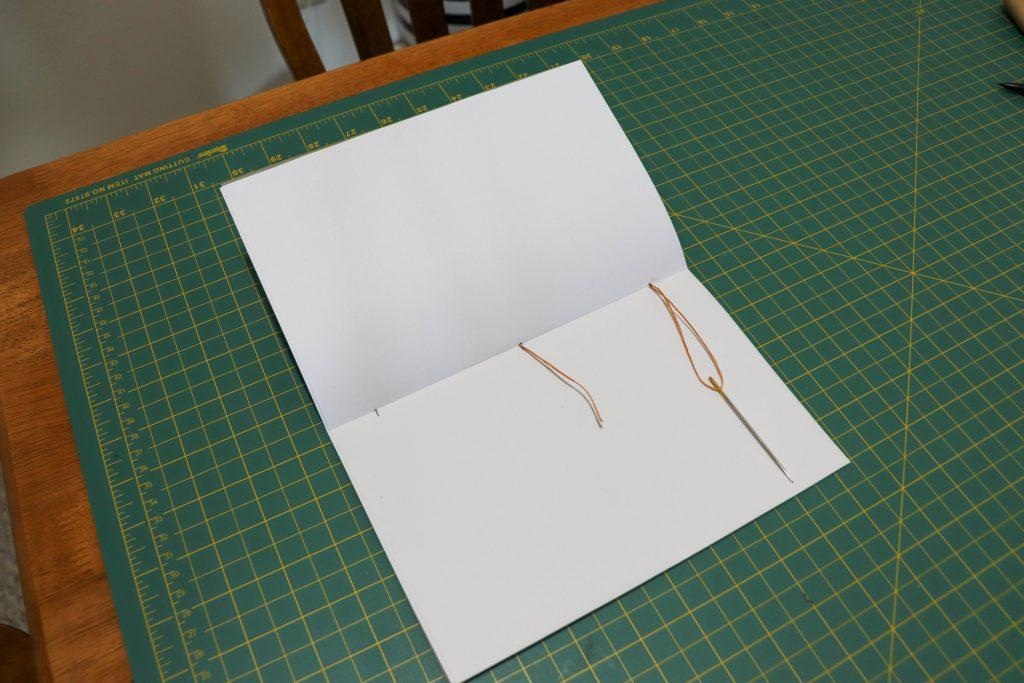
Figure: Pamphlet sewing through the centre fold of a booklet. Source: University of Illinois Library Conservation Laboratory.
Advantages of Sewn Binding: It can provide a durable connection between pages, permit relatively comfortable opening and support the long-term usability of books when the materials and construction are appropriate.Limitations of Sewn Binding: Sewing may require more time, specialised equipment or skilled labour. Some methods, particularly oversewing and side sewing, may restrict opening or damage pages near the inner margin.
6. Adhesive Binding
Adhesive binding is a method in which pages are secured using an adhesive applied along the spine or adjoining edges of the text block. It is widely used in commercial book production because it can be economical, efficient and suitable for large-scale manufacturing.The effectiveness of adhesive binding depends on the adhesive formulation, preparation of the spine, characteristics of the paper and the quality of the binding process.
- Perfect Binding: Perfect binding involves securing a stack of individual leaves with adhesive along the spine and attaching a flexible cover. It is commonly used for paperback books, catalogues, reports and other commercially produced publications.In a typical perfect-binding process, the spine edge is prepared, adhesive is applied and the cover is attached. Many commercial systems use hot-melt adhesives, although other adhesive formulations are also used. Perfect binding is relatively economical and suitable for mass production. However, its durability and ability to open comfortably depend on the quality of the adhesive and construction. Poorly manufactured volumes may lose pages or develop cracked spines after repeated use.
- Double-Fan Adhesive Binding: Double-fan adhesive binding is a method in which individual leaves are fanned in one direction while adhesive is applied near their spine edges. The leaves are then fanned in the opposite direction, and adhesive is applied again. This process allows adhesive to reach a small portion of the adjoining surfaces of individual leaves, rather than remaining primarily on the outer spine surface. Double-fan adhesive binding is important in library rebinding because it can produce a flexible and secure text block that opens relatively well. Suitable polyvinyl acetate (PVA) adhesives are frequently used in this process. The method is particularly useful for some damaged adhesive-bound books and periodical volumes consisting of separate leaves.
- Thermal Binding: Thermal binding involves using heat to activate or soften an adhesive that secures the pages. It is commonly employed in office and document-binding systems. Thermal binding can be convenient for reports and other materials requiring quick assembly. However, its long-term durability depends on the binding system and adhesive used. It should not automatically be regarded as preservation-quality binding.
Advantages of Adhesive Binding: It is generally economical, can be completed efficiently, produces a comparatively neat spine and is suitable for many paperback books, reports and periodical volumes.
Limitations of Adhesive Binding: Adhesive deterioration, inappropriate paper characteristics or defective construction may result in detached pages, cracked spines and restricted opening. Some damaged volumes may require professional rebinding.
7. Mechanical Binding
Mechanical binding involves securing pages through physical fasteners rather than relying primarily on thread or adhesive. The fasteners may consist of wire, staples, plastic combs, metal coils, rings or binding posts.Mechanical binding is commonly used for reports, manuals, booklets, project documents and materials that require frequent updating or convenient page turning.
- Saddle-Stitched Binding: Saddle stitching involves driving staples through the centre fold of a booklet. The folded sheets are placed together, and the staples hold them along the fold. This is a common method for thin magazines, brochures and booklets. Although it is called stitching, ordinary commercial saddle stitching usually employs metal staples rather than thread.
- Side-Stapled Binding: In side-stapled binding, staples pass through a stack of sheets near one edge rather than through a central fold. It is suitable for relatively thin documents, although the bound pages may not open as freely as saddle-stitched pages.
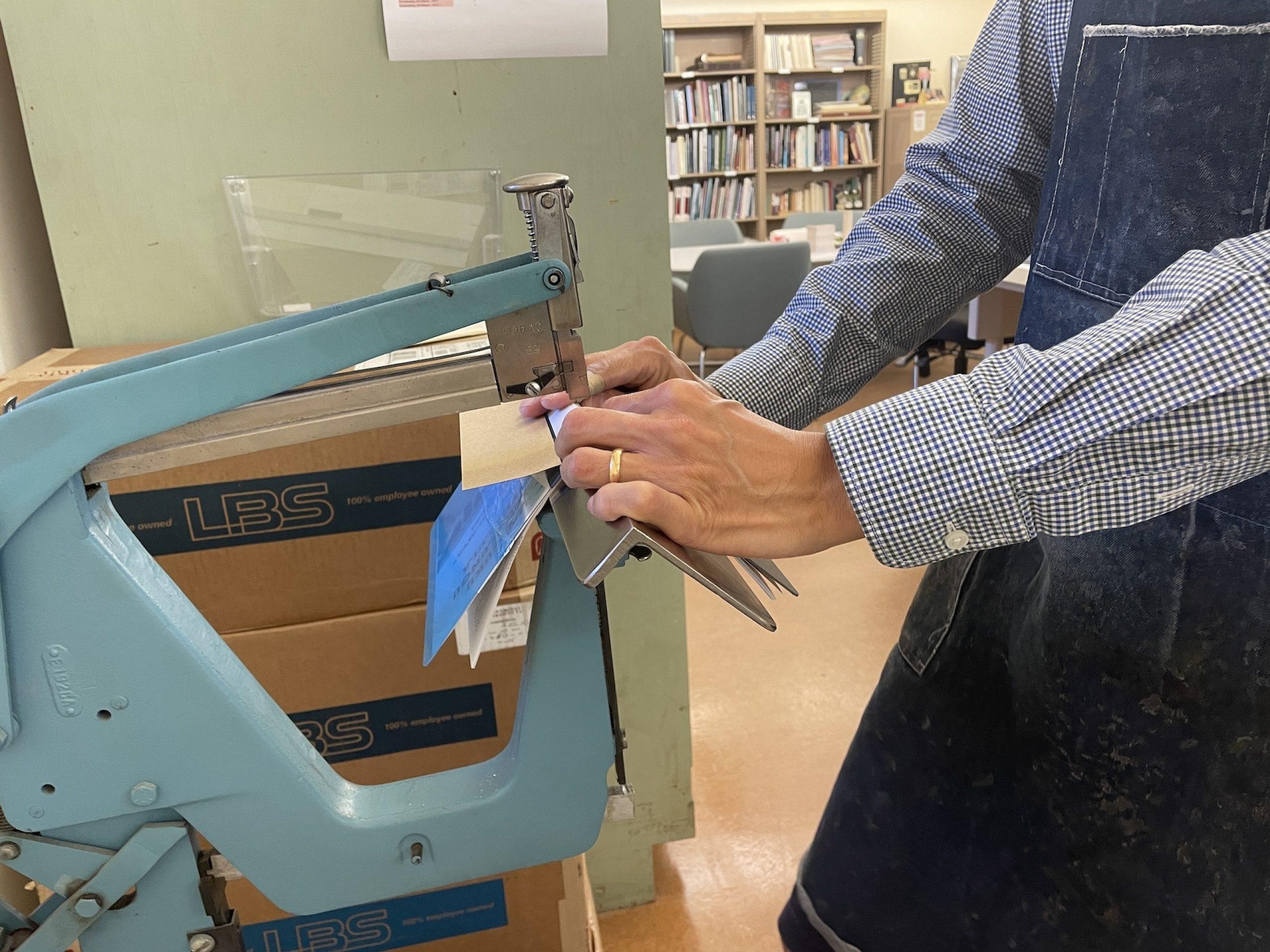
Figure: Saddle-stapling equipment used for binding folded pamphlets. Source: UCLA Library.
- Spiral or Coil Binding: In spiral binding, a continuous plastic or metal coil passes through holes punched along one edge of the sheets. It allows the pages to turn easily and, in suitable constructions, rotate through approximately 360 degrees. Spiral binding is commonly used for training manuals, notebooks, laboratory records and instructional materials.
- Wire Binding: Wire binding, including double-loop wire binding, uses shaped metal wire elements inserted through holes along the edge of a document. It provides convenient page turning and is frequently used for calendars, reports and notebooks. However, the wire may become bent or distorted through repeated handling.
- Comb Binding: Comb binding uses a plastic strip with curved teeth inserted through rectangular holes punched along the sheets. The pages can be assembled or replaced using appropriate equipment. It is commonly used for dissertations, reports, project documents and instructional materials. Its main limitation is that plastic combs may break or deform, particularly with frequent use.
- Ring and Post Binding: Ring binding uses rings passing through punched holes to hold loose sheets together. Post binding uses metal or plastic posts inserted through aligned holes. These methods are useful when pages need to be inserted, removed or rearranged. They are commonly associated with loose-leaf manuals, albums and some administrative documents.
Limitations of Mechanical Binding: Fasteners may rust, break, bend or damage holes in the paper. Mechanical bindings may also be less suitable for long-term preservation of fragile or historically important documents.
8. Binding According to Cover Construction and Materials
Bindings may also be classified according to the construction and materials of their covers. These characteristics should be distinguished from the methods used to join the pages.- Hardcover or Case Binding: In case binding, the protective cover is generally manufactured separately from the text block. The cover normally consists of rigid boards covered with cloth, paper, leather or another suitable material. The assembled text block is subsequently attached to the case, often through the endpapers and related structural components. Case binding is widely used for textbooks, reference books and other publications requiring relatively durable covers. The pages inside the case may be sewn or adhesive-bound.
- Paperback or Softcover Binding: Paperback binding uses a flexible paperboard cover rather than rigid boards. The pages are commonly adhesive-bound, although sewn paperback structures also exist. Paperback binding is generally lighter and less expensive than hardcover binding, but the cover may offer less protection against heavy handling.
- Cloth Binding: Cloth binding uses textile material, such as cotton, linen or specially manufactured book cloth, as the covering. Strong book cloth, including suitable buckram, is commonly used in library bindings because it can withstand routine handling. Durability depends on the material and quality of construction.
- Leather Binding: Leather binding uses prepared animal skin as the covering material. It is associated with many historical, fine and special bindings. Leather may provide considerable durability when properly selected and maintained, but some historical leather coverings are susceptible to chemical deterioration, including powdering known as red rot.
- Full, Half and Quarter Binding: These terms describe the extent and distribution of covering materials. A full binding generally uses the same principal material over the spine and boards. A half binding traditionally uses leather or another material over the spine and corners, with different material on the remaining board surfaces. A quarter binding generally uses one material over the spine and a different covering over the boards.
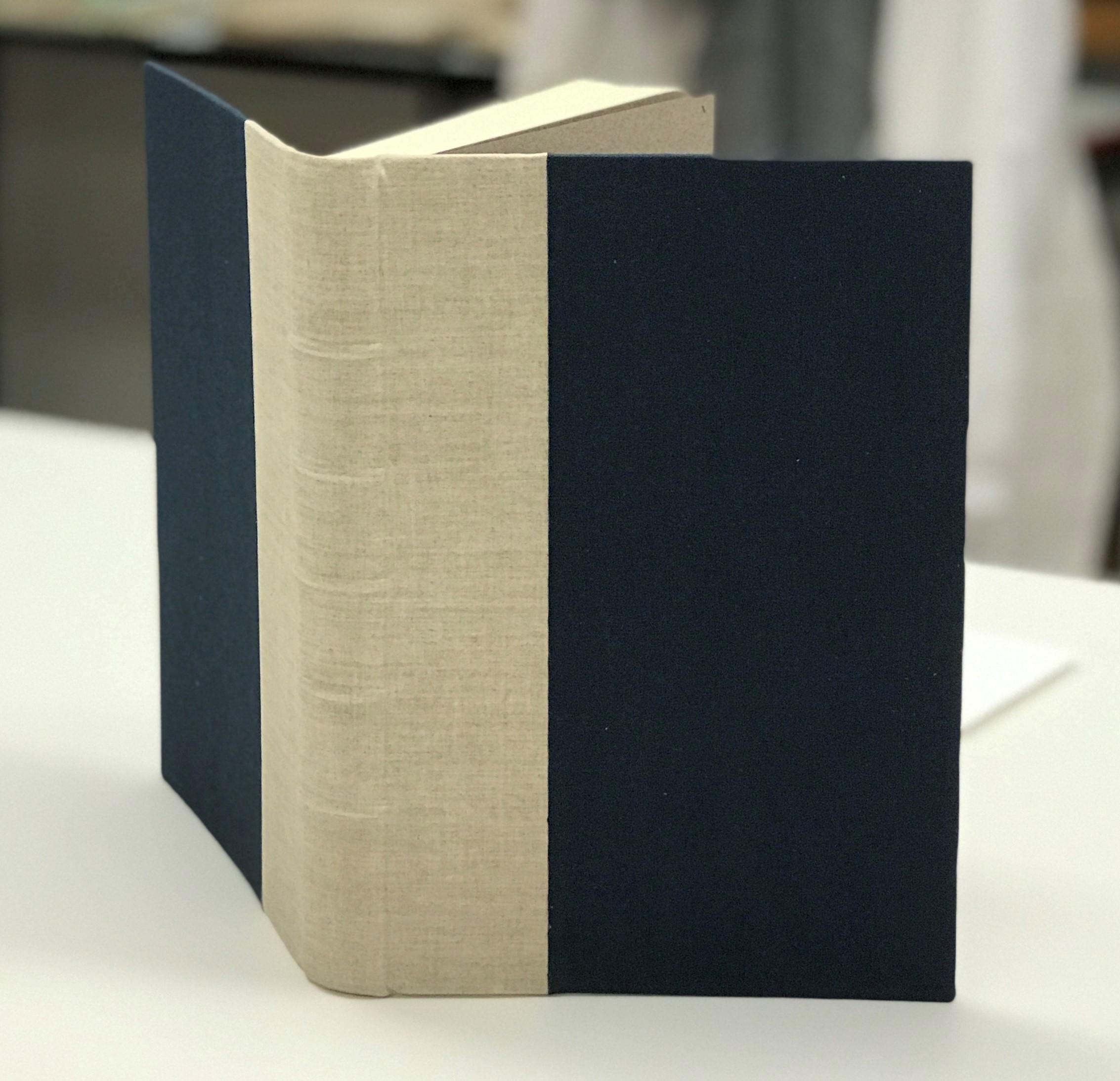
Figure: Quarter-linen binding model showing contrasting covering materials on the spine and boards. Source: The Preservation Lab.
Important Distinction: Hardcover, paperback, cloth and leather bindings describe the outer construction or covering. They do not independently identify whether the pages have been sewn, glued or mechanically secured.
9. Types of Binding According to Library Requirements
Libraries employ different binding approaches according to the nature of their collections, expected frequency of use and preservation requirements.- Publisher's Binding: Publisher's binding refers to the binding supplied when a book is originally manufactured and published. It may be hardcover, paperback, sewn or adhesive-bound. Commercial publishers generally select binding methods according to production cost, physical characteristics and expected market requirements. Some publisher's bindings are sufficiently durable for library use, while others may require reinforcement or eventual replacement.
- Library Binding: Library binding is intended to withstand repeated handling and circulation while protecting the text block and maintaining good opening characteristics. It commonly involves durable covering materials, suitable page attachment methods and reinforced structural components. Library binding may be applied to new paperback books, accumulated periodicals or damaged circulating volumes. A principal objective is to create a durable and serviceable volume without unnecessarily altering the original material.
- Periodical Binding: Periodical binding involves assembling separate issues of a journal, magazine or other serial publication into a single volume. The issues are usually arranged in their correct numerical or chronological sequence before binding. Periodical binding helps maintain the completeness of a serial collection and simplifies storage, identification and consultation. The binding may use sewing or adhesive methods depending on the construction and condition of the issues. For example, twelve monthly issues of a scholarly journal may be assembled into a bound annual volume. The completed volume may include appropriate spine lettering indicating the journal title, volume number and publication year.
- Pamphlet Binding: Pamphlet binding is used for thin publications that do not possess sufficiently durable covers or independent binding structures. Pamphlets may be sewn through their central folds and placed in protective binders. For valuable or brittle pamphlets, protective folders or archival enclosures may be preferable to direct binding. This approach helps protect fragile materials without introducing unnecessary holes, adhesives or structural alterations.
- Thesis and Dissertation Binding: Thesis binding is used for academic dissertations, research reports and other institutional submissions. Methods may include hardcover case binding, adhesive binding, spiral binding or comb binding. The selected method generally depends on institutional submission requirements, document thickness, expected use and retention arrangements. Where the institution requires a permanent printed archival copy, a durable construction is usually preferable to a temporary mechanical binding.
- Conservation Binding: Conservation binding involves selecting or constructing a binding that protects a damaged or historically important book while respecting its original physical characteristics and documentary significance. Unlike ordinary commercial rebinding, conservation binding prioritises minimal intervention, material compatibility, preservation of original evidence and professional treatment standards.
10. Comparison of Major Binding Types
The following table summarises the principal differences among commonly used binding methods.| Binding Type | Main Technique | Common Application | Principal Limitation |
|---|---|---|---|
| Section-Sewn | Thread through folded sections | Durable books and selected conservation bindings | Labour and production cost |
| Oversewn | Thread through individual leaves near the inner margin | Certain heavy or thick library volumes | Restricted opening and possible page damage |
| Perfect Binding | Adhesive along the spine | Paperbacks and commercially produced books | May weaken with repeated use |
| Double-Fan Adhesive | Adhesive applied between fanned leaf edges | Library rebinding and periodical volumes | Requires suitable paper and careful workmanship |
| Saddle-Stitched | Staples through the central fold | Thin booklets and magazines | Limited suitability for thick publications |
| Spiral or Comb | Mechanical fasteners through punched holes | Reports, manuals and project documents | Fasteners may break or deform |
| Case Binding | Text block attached to a separately made rigid cover | Hardcover books and library volumes | Quality depends on internal structure and cover attachment |
For example, section sewing may be suitable for a durable reference book, while saddle stitching may be sufficient for a thin pamphlet. A heavily used modern paperback may benefit from library rebinding, whereas a rare historical book may require conservation treatment rather than a stronger commercial binding.
11. Selection of Appropriate Binding for Library Materials
Selecting an appropriate binding method is an important collection maintenance decision. Libraries should consider the physical characteristics of the material, expected use, preservation value and available financial resources.- Nature of the Material: Books, periodicals, pamphlets, manuscripts and reports may require different binding methods because of differences in their construction and intended use.
- Paper Quality and Condition: Strong, flexible paper can tolerate certain binding procedures more easily than brittle or weakened paper. Fragile materials may be damaged by trimming, sewing or adhesive application.
- Thickness and Size: The number of pages, weight and dimensions of a document influence the suitability of particular binding structures.
- Frequency of Use: Heavily circulated books require bindings capable of withstanding repeated handling. Materials that are consulted infrequently may have different preservation requirements.
- Ease of Opening: A suitable binding should allow comfortable consultation without placing excessive stress on the text block. Opening characteristics are especially important for reference books and materials requiring prolonged examination.
- Historical and Artifactual Value: Rare books, manuscripts and original historical bindings may possess value beyond their informational content. Such materials should not be routinely rebound without professional conservation assessment.
- Cost and Durability: Libraries must balance initial expenditure with expected binding performance and long-term maintenance costs.
- Availability of Binding Services: The quality of the binding depends upon appropriate equipment, suitable materials and skilled workmanship. The availability of professional library binders or conservators may influence the selection process.
12. Standards and Quality Requirements for Library Binding
Standardisation helps libraries obtain consistent and reliable binding services. It establishes technical requirements concerning materials, construction methods, durability and workmanship.ANSI/NISO/LBC Z39.78-2000 (R2018): Library Binding: This American National Standard, published through the National Information Standards Organization (NISO), provides specifications for the first-time hardcover binding of suitable paperbound books and serials, as well as the rebinding of hardcover books and serial publications intended for library use.
The standard addresses suitable materials and technical requirements associated with durable library binding.
Important Quality Requirements:
- Durability: The binding should withstand the expected conditions of handling, shelving and circulation.
- Flexibility: The bound volume should open comfortably without placing unnecessary strain on the text block.
- Minimal Alteration: Binding procedures should preserve original margins, pages, illustrations and other important characteristics wherever possible.
- Material Stability: Boards, covering materials, adhesives, thread and endpapers should be selected for appropriate strength, durability and chemical stability.
- Structural Integrity: The connection between pages, spine and covers should remain secure during ordinary use.
- Workmanship: Binding operations should be completed accurately, with proper page sequence, alignment and attachment.
For rare books and materials of historical or artistic value, ordinary library binding standards do not replace the need for professional conservation assessment.
Quality Inspection: Libraries should inspect volumes returned from a commercial binder to confirm correct page sequence, secure attachment, appropriate opening, accurate spine lettering and compliance with the agreed specifications.
Binding is therefore an important part of collection preservation and maintenance, but it must be carried out with an understanding of the material being treated. The main purpose is to maintain the physical integrity, accessibility and continued usability of library materials while avoiding unnecessary alteration or damage.